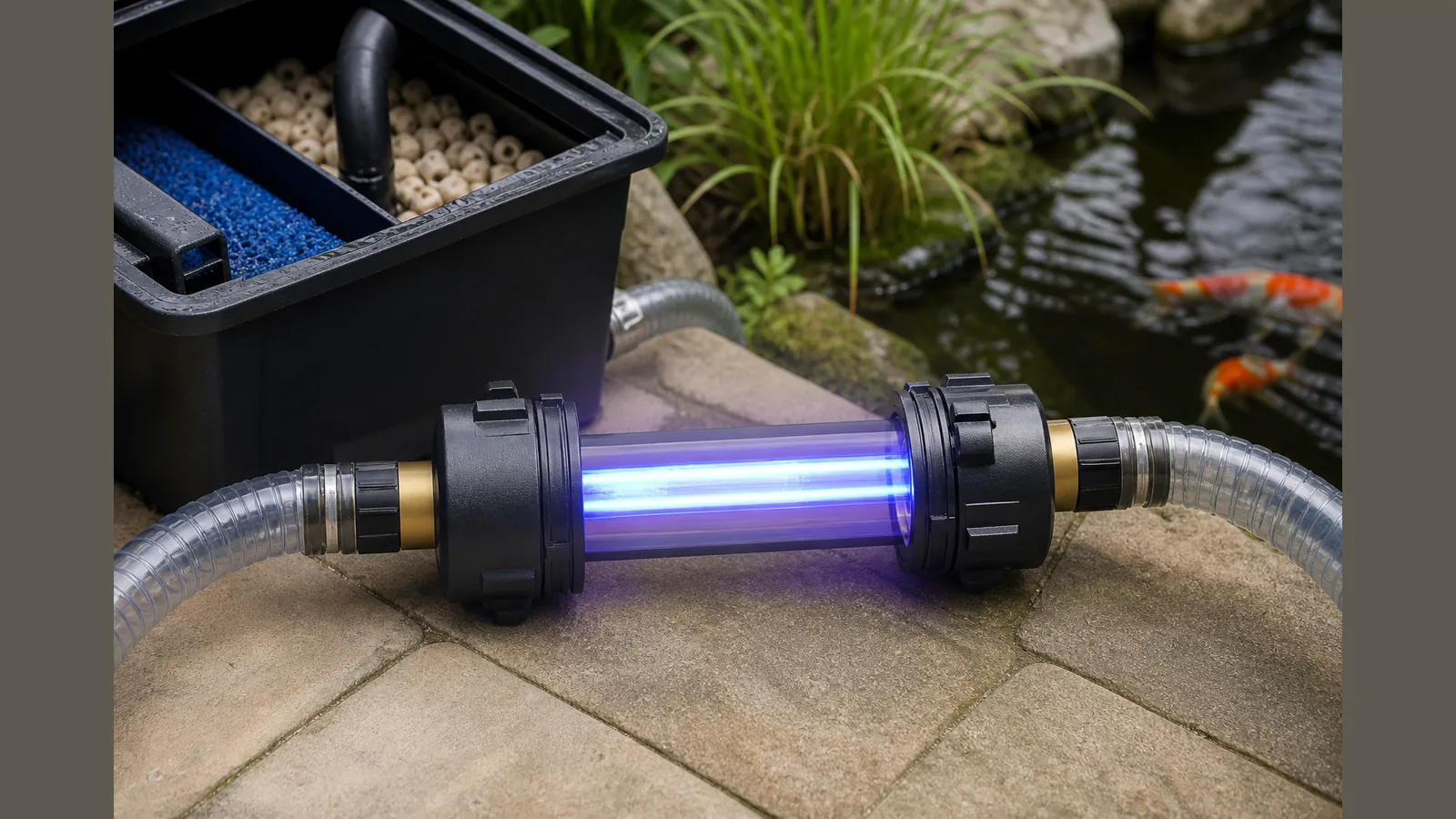
How a pond UV steriliser works UK: UK Practical Guide
In the UK, how a pond UV steriliser works UK is best understood as a flow-through clarifier stage: pond water is pumped past an Ultraviolet-C (UVC) lamp so free-floating algae and some waterborne organisms are exposed to UVC before the water returns to the pond. It supports clearer water when matched to your pump and filter setup; it does not replace filtration, and clear-water results are not guaranteed on a fixed timeline.
Plain-English definition
A pond UV steriliser (often called a UV clarifier) is an enclosed unit fitted in the return line after your pump or filter. As water passes the lamp sleeve, UVC radiation helps manage water quality by acting on particles and organisms carried in the flow. In plain terms, it is a clarity aid that works on water that actually reaches the lamp—not a chemical treatment and not a cure-all for every pond problem.
Public pond-care guides describe the same basic idea: a pond UV system uses UVC to support clearer water and algae control when used as part of a wider setup.
How it relates to the job
The job of a UV steriliser is to treat water in motion. Placement in the circulation path matters because only water that flows through the unit is exposed. Guides on UV pond filters and clarifiers typically cover how UV relates to algae and pathogens, how to choose a unit that suits your system, and where to site the clarifier so contact with the lamp is reliable.
For an inline 9W class unit (such as a CUV-209 class 9W inline pond UV steriliser / clarifier), the practical point is the same: match the steriliser to your pond’s circulation and filtration, keep the quartz sleeve clean so light can reach the water, and treat UV as one stage beside mechanical and biological filtration—not instead of them.
- Run water through the unit whenever you want UV exposure; stagnant bypass water is untreated.
- Keep pre-filtration sensible so debris does not shade the lamp sleeve.
- Size and flow must stay within the product’s rated limits—never exceed rated limits for a pond UV steriliser.
What not to invent
When reading marketing or comparing models, stay within what is actually evidenced. Do not assume kill-rate percentages, guaranteed “glass clear” dates, bulb-life hours beyond manufacturer guidance, certifications, test scores, or plug and voltage details that are not stated for the specific SKU.
Common mistakes using a pond UV steriliser in the UK include expecting UV alone to fix green water caused by excess nutrients, running the unit with a dirty sleeve, ignoring flow that is too fast or too slow for the lamp chamber, and treating warranty wording as a performance promise. A confirmed 12-month warranty covers the purchase period; it does not prove clearance speed or pathogen kill rates.
UK framing
For UK ponds, how to choose a pond UV steriliser UK usually comes down to honest matching: pond volume and fish load, pump flow, filter type, and whether an inline clarifier fits your pipework. Prefer British English product pages and local advice that explain algae control and water clarity without inventing specs.
If you need a compact inline option in the 9W class, review the listed product facts on the detail page rather than copying claims from unrelated models. Missing or unpublished details—such as exact UK plug type, live price, or image licences—should be left unstated until confirmed.
Next step
If an inline 9W clarifier fits your filtration plan, check the 9W inline pond UV steriliser product details for the current description, warranty note, and installation points before you buy.
FAQ
Does a UV steriliser replace a pond filter?
No. UV supports clarity by treating water in the line; mechanical and biological filtration still remove waste and support the pond ecosystem.
Will UV give crystal-clear water by a set date?
No reliable public claim sets a fixed UK timeline. Clarity depends on load, nutrients, flow, sleeve cleanliness, and the rest of your system.
What should I avoid when choosing a unit?
Avoid inventing compatibility, wattage “rules of thumb” without product guidance, and exceeding rated flow or power limits. Use the manufacturer’s stated class and limits for the model you install.